Wednesday, September 24, 2014

It's Water-Wise Wednesday with Frannie the Fish! {Water Leak Detectives}

Did you know that 10% of homes in the United States have water leaks that waste more than 90 gallons of water a day? (www.epa.gov) 

In order to find and diagnose common household leaks, Frannie invented a fun, new game called Water Leak Detectives! You and your troop can play this game together, or you can play it at home by yourself with the help of a parent or guardian.

In Water Leak Detectives, you will play the role of the detective on search for water leaks! A successful detective will need the following items:
  • Notepad
  • Writing Utensil
  • Food Coloring
  • Flashlight
Frannie is ready to be a Water Leak Detective!
The first place to start when playing Water Leak Detectives is at the water meter. A water meter is a device used to measure the amount of water a household uses. You will have to use your detective skills to locate the water meter in your house! Common locations include an outside wall, under the sink, or in the basement. 
Frannie's water meter is in her basement by the water heater.
It's dark down there, so she needed a flashlight
to read the numbers on the meter.
Once you find your water meter, record the number on the dial. This number tells you how much water a household has used. If this number increases when no water is being used, that means there is a leak! Frannie recommends waiting at least an hour without using any water before checking to see if the number has changed.

If your water meter didn't change during that hour - congratulations! Your household is leak-free. However, if the number changed even a small amount, you have a leak somewhere in the house that needs to be repaired. Now you need to continue using your detective skills to find that leak!

Toilets are often the culprit of unseen leaks. To check to see if a toilet has a leak, Frannie recommends placing one drop of food coloring in the toilet tank and waiting 15 minutes to see if any of the color shows up in the toilet bowl. If color shows up in the bowl - you have found a leak! Make sure to flush the toilet right away after this experiment to prevent any staining to the toilet.
Frannie used green food coloring to check for a toilet leak.
Thankfully, there was no leak!
Water faucets are also common locations of water leaks. These leaks can sometimes be easily diagnosed by dripping from the faucet head. However, sometimes the leak can occur under the sink. Frannie recommends using your flashlight to explore all around a faucet and sink, including underneath the sink, to search for any signs of a water leak.
Frannie checked under all of her sinks for a sign of a leak.
If your toilets and faucets are in good condition, and you still haven't found the leak, here are some other places Frannie recommends checking for leaks:
  • Showerheads
  • Water Heater Tanks
  • Washing Machines
  • Dishwashers
  • All Outdoor Faucets/Garden Hoses

If you still haven't found the leak, not to worry! Even good detectives need help sometimes. Frannie recommends having an adult call an expert plumber to help you diagnose the leak.

And, of course, once you find the leak it is important to tell an adult about the leak so that they can fix it or bring in an expert to fix the leak!

Happy sleuthing, Water Leak Detectives!

Want to share your detective experience? Tell Frannie about it here.


Wednesday, September 17, 2014

It's Water-Wise Wednesday With Frannie the Fish {Edible Aquifers}

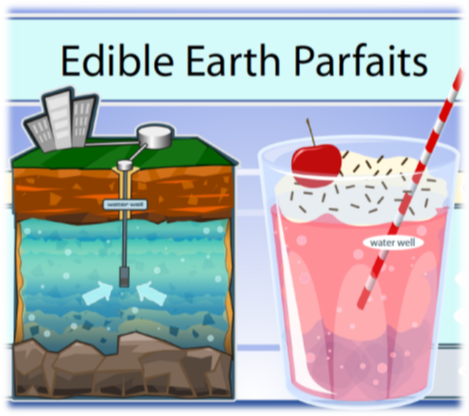
Frannie likes to learn about groundwater by using hands on activities, so this week she is going to help you learn all about aquifers by creating your own yummy treats! 


Edible aquifers are a fun and easy way to understand the geology of an aquifer. Your edible aquifer will help you learn about confining layers, contamination, groundwater recharge and water tables!

Here is what you will need to make your edible aquifer: 
Clear plastic cups
• Ice cream scoop
• Spoons
• Drinking straws
• Blue/red food coloring
• Vanilla ice cream or fruity sorbet
• Clear soda pop
• Small gummy bears, chocolate chips, crushed cookies, breakfast cereal, or crushed ice
• Variety of colored cake decoration sprinkles and sugars


What you will need to do: 
1. Begin to make your edible aquifer by filling the clear plastic cup 1/3 full with gummy bears,
chocolate chips, or crushed ice (This represents sand and gravel).
2. Add enough soda (this represents the water) to just cover the candy/ice.
3. Add a layer of ice cream to make a “confining layer” over the water-filled aquifer.
4. Then add more “sand/gravel” on top of the confining layer.
5. Colored sugars and sprinkles will represent soils and should be sprinkled over the top to create the
porous top layer. 

6. Now add the food coloring to the soda. The food coloring represents contamination. Pour the colored soda over the top of the aquifer.
7. Watch what happens when it is poured on the top of the aquifer. This is what happens when contaminants are spilled on the earth’s surface.
8. Using a drinking straw, drill a well into the center of your aquifer by poking the straw through the aquifer.
9. Slowly begin to pump the well by sucking on the straw. Watch the water go down in the water table.
10. Notice how the contaminants can get sucked into the well area and end up in the groundwater by
leaking through the confining layer.

11. Now recharge your aquifer by adding more soda which represents a rain shower.
12. Review what you have learned as you enjoy eating your edible aquifer.


Here is a video that shows you step by step how to make your edible aquifer!

If you would like more hands on activities that can help you learn about groundwater, visit the Kid's Corner on The Groundwater Foundation website!

Wednesday, September 10, 2014

It's Water-Wise Wednesday with Frannie the Fish! {Dual Flush Toilets}

Did you know that a family of four uses 400 gallons of water a day on average in the United States (US EPA)? That's a lot of water! Furthermore, the top consumer of that water is the toilet!


In order to conserve water in her home, Frannie decided to upgrade her toilets to dual flush!


Dual flush toilets have two flushing options: a full flush for solids and a reduced flush for liquids only. Studies show that dual flush toilets use an average of 1.3 gallons per flush (US EPA). By upgrading her toilets to dual flush, Frannie will use about 20% less water!


Frannie's dual flush toilet handle. She presses the single droplet for liquids only and the double droplet for solids.

One of Frannie's favorite things about dual flush toilets (other than how much water they save, of course) is how easy they are to install. Upgrading her toilet only took Frannie about 30 minutes with the help of an adult!


How do you conserve water in your household? Share your story with Frannie here! It might even be featured on the blog!

Wednesday, September 3, 2014

It's Water-Wise Wednesday With Frannie the Fish! {Water1der}

Frannie’s favorite way to learn about groundwater is to play fun and educational games. That's why Frannie loves Water1der! 

Water1der is The Groundwater Foundation’s mobile app that helps teach you all about groundwater! It’s fun and easy to play and you can download it to your Apple device for free from the Apple Store!


Frannie loves quizzing her friends and learning more about groundwater by using Water1der. Click here to download Water1der so you can start quizzing your friends and learning more about groundwater too!


Don’t have an Apple device, but you still want to learn more about groundwater through fun games and activities? Check out The Groundwater Foundation’s kids' corner for games, puzzles, and hands on activities you can do at home!

Wednesday, August 27, 2014

It's Water-Wise Wednesday With Frannie the Fish! {Frannie's Summer Vacation}

Do you ever wonder how pollution hurts Frannie and other fish like her? Frannie just got back from her summer vacation and she encountered a lot of water pollution. Fish, like Frannie, need cool, clear streams to live in. This week's Water-Wise Wednesday is the story of Frannie's summer vacation. Her story can help you learn about water pollution and how it can affect a clear stream and eventually make it unhealthy for wildlife such as Frannie. Below are some instructions on how to tell Frannie's story. Share it with friends, family or other Girl Scouts so they can learn from Frannie's adventure too! 


Items Needed:
  • A Frannie stand-in: You can use a fishing lure, one that looks like a fish, with the hooks removed 
  • Fishing line to suspend Frannie in a gallon jug or fish bowl of clear water
  • Gallon jug or fish bowl or small fish aquarium
  • Pencil, stick, or ruler placed on the top of the container to hold Frannie suspended halfway in the jar, underwater. 
  • 8 small containers or plastic bags to hold the "contaminants." See provided list of items needed for the contaminants.
Frannie should look like this in the bowl: 
Items Needed for the Contaminants:
1. Sediment - Potting soil, sand, and gravel mix
2. Manure - Raisins, dry beans, or chocolate-puff cereal  

3. Fertilizer - Green powdered drink mix
4. Road Salt - Denture cleaner or antacid tablet  
5. Litter - Torn paper and plastic bits 
6. Motor Oil - Vegetable oil  
7. Acid Rain - Cider or white vinegar tinted orange with food dye
8. Leaking Storage Tank - Film canister or similar small container with a cracked/open lid with red/blue food dye and water.


Sharing the story:
Make up an introduction to introduce Frannie to the group. Here is a sample intro:

"This is my friend Frannie. Can everyone say hi to Frannie? Today I'm going to help tell Frannie's story. Frannie is 7 years old and sometimes gets bored in her home, Holmes lake. Do you guys ever get bored and wish you could go some place else? Well, Frannie thought she would go on an adventure. Let's go along with Frannie on her adventure." 


Tell the rest of Frannie's story...

Frannie leaves her shady, cool pond and heads downstream on her adventure. 

After a little while, Frannie noticed that the sun was shining and the stream was no longer as cool and
dark. She looked out of the water and noticed that all the trees had been cut down and sediment (soil)
from the banks was washing into the water. 


Add first item to bowl- sediment: Sprinkle some sediment over the water and allow it to slowly
settle over Frannie.


Things you can discuss: Do you like to get sand in your gills...eyes? Fish breathe through gills. The sandy grit from the soil can hurt fish gills. The sediment can also cover rocks where fish lay their eggs, making it difficult for new fish to hatch.

“Oh no! Poor Frannie!” (Get your audience to repeat this every time something “bad” happens to Frannie.)


After a while Frannie poked her nose out of the water and do you know what she saw? Big black and
white animals coming down to visit her. Cows. As they walked into the water they stirred up mud and
left some smelly “presents.” 


Add second item to bowl- manure: Sprinkle some raisins and let them sink in the water. 


Things you can discuss: Animal waste can be harmful to aquatic life. Decomposing animal waste uses
up oxygen and releases pollutants (nutrients, phosphorous, and ammonia) in the water. Fish like
Frannie are not able to survive without enough oxygen and cannot survive with the added pollutants in the water. 


“Oh no! Poor Frannie.”


Frannie continued to swim downstream, but was no longer feeling very well.

Add third item to bowl- fertilizer: Sprinkle green powdered drink mix into the bowl.


Things you can discuss: Did you know, fertilizers can wash off the grass from rain or watering and run
off into the stream? Fertilizer is food for plants. It is often given to plants so they can grow bigger and
faster. Fertilizer will also makes plants and algae in the water grow. Too many plants in the water can
be bad for fish like Frannie.


“Oh no! Poor Frannie."

 
Frannie wasn’t ready to go home and continued to swim downstream.

Frannie noticed that the river had a salty taste.

Add fourth item to the bowl- road salt: Dump in
the denture cleaner or antacid tablet .
 
Things you can discuss: Road salt can help melt ice and is good for traffic safety but bad for wildlife,
trees, and water under the ground. Have you ever gotten salt in a cut? Ouch! Have you ever drank salt
water? Did you like it?


“Oh no! Poor Frannie.”


Frannie began to swim faster to escape the salt.


Downstream Frannie passed a picnic site. Someone left their trash behind. What is a more responsible
action you would do? Right then, a big gust of wind came and pushed most of the trash right into
the stream. Frannie doesn’t like this mess at all! Frannie tried to push the litter out of the stream but
couldn’t get it all with her little flippers. 


Add 5th item to bowl- litter: Add the litter into the bowl with Frannie.


“Oh no. Poor Frannie!”

 
She continued to swim downstream. Determined to continue her adventure.


Frannie heard a lot of commotion up on the bank of the stream. She peeked out of the water and saw
an overturned oil truck. Some of the oil from the truck had spilled into the stream! Frannie could get her gills clogged with oil. If this happens she would have trouble breathing.


Add sixth item to bowl- oil: Pour in the vegetable oil.


“Oh no. Poor Frannie.”


As Frannie continued to swim away from the oil spill, she noticed storm clouds overhead. The rain that
began to fall into the stream from the storm clouds wasn’t clean water. Frannie’s scales begin to itch!


Add seventh item to bowl- acid rain: Pour vinegar dyed with food coloring into the bowl. 


Things you can discuss: When air pollutants react with water drops this can cause rain to be polluted. This is called acid rain.


“Oh no! Poor Frannie.”


Frannie passed a leaky, rusty old barrel. An unknown substance was leaking out. An old factory dumped
the tank into the river many years ago. But now the barrel was leaking. As Frannie swims by she takes in
a gulp of water.


Add eighth item to bowl-Leaking Storage Tank.

“Oh no! Poor Frannie!”


Frannie was exhausted from her wild day. She was ready to go back home to her cool clear pond!


Things you can discuss: Fish, especially Frannie and her other aquatic friends, like cool, clean water to live
and play in. They like vegetation along the bank to shade the water and keep it cool. The cooler the water the more oxygen for her to breathe. Plus, insects and leaves from vegetation fall into the water providing food for Frannie and her friends.


What can you do (with the help of friends and family) to help keep Frannie’s home and all water clean? Share your ideas with us here!