Wednesday, April 13, 2016

It's Water-Wise Wednesday with Frannie the Fish {Visit a Stream}

This week Frannie wants to share a fun activity that incorporates math, getting outdoors and having fun all while learning about water! Visit a Stream is a fun way to calculate the flow rate of the water in a stream or river! Flow rate is the time required for a volume of water to move between two points.


Here's what you'll need:
  • Tape measure
  • Several sticks
  • Stopwatch
  • Calculator
  • Pencil and paper


Here's what you do:
1. Be sure to read through The Groundwater Foundation's Safety First document.
2. Measure a 100-foot distance along the bank of a stream. Place a group of Girl Scouts at the upstream end of the stream with the sticks, and the other group downstream 100 feet away with the stopwatch.


3. When both groups are ready, the upstream group places a stick in the river and the downstream group times how long it takes for the stick to reach them.
4. Switch the groups and repeat the process several times, recording the data on a sheet of paper to compute the average. Have the Girl Scouts calculate how many feet per second the river is flowing (100 feet divided by the time in seconds = feet per second). For example,
100 feet ÷ 53.5 seconds = 1.87 feet per second

The water in the stream is moving 1.87 feet every second!

For more fun!
Move to another part of the river and repeat. Or try this activity at different rivers or several different sections of the same river. Have the Girl Scouts compare and contrast the different rivers/sections, noting any physical features that may affect the speed of the water. For example:
  • Curves
  • Straightaways
  • Slight downhill flows
  • Rocks
  • Islands
  • Etc.

Share pictures of your troop visiting a stream to be featured on Frannie's Blog!

Wednesday, April 6, 2016

It's Water-Wise Wednesday with Frannie the Fish {Rain Gardens}

Spring has sprung! Frannie wants to share a great activity you can do with your troop that will have far-reaching positive impacts for your community and groundwater - installing a rain garden. A rain garden is a garden of native shrubs, perennials, and flowers planted in a small depression, which is generally formed on a natural slope. It is designed to temporarily hold and soak in rain water runoff. Rain gardens help filter out pollutants such as fertilizers, chemicals, bacteria, and others contained in runoff. They also incorporate native vegetation, reducing the need for fertilizers and after the first year, maintenance is usually minimal. Here are just a few of the benefits rain gardens provide:
  1. Improves water quality by filtering out pollutants. Rain gardens are effective in removing up to 90% of nutrients and chemicals and up to 80% of sediments from rainwater runoff.
  2. Allows for 30% more water to soak into the ground than a conventional lawn.
  3. Attracts beneficial birds, butterflies and insects.
  4. It looks great!

Work with your Girl Scout troop and local community to find an appropriate area to install a rain garden. Here are some helpful tips from Frannie to get you started:
  •  Check with your local nursery for a list of rain garden approved native plants. These plants don't require fertilizer, have good root systems, and are better at utilizing water and available nutrients than non-native species.
  • A rain garden should have an area about 20% the size of the roof, patio, or pavement area draining into it.
  • A rain garden should be longer than it is wide and positioned perpendicular to the slope of the land in order to catch the maximum amount of rainfall.
  • The cost of a rain garden is dependent on a lot of factors (soil type, size, types of plants, etc.). But you can expect to pay between $3 and $5 per square foot in plant costs and soil amendments (a soil amendment is something added to alter the properties of the soil, for example, peat moss should be mixed with soil with high levels of clay).
  • Find out more about installing your own rain garden here!


A troop working hard can install a rain garden in an afternoon. Digging the garden is the most time consuming part, as 6-8 inches of soil is typically removed to add amendments. Conduct an infiltration test and a ribbon soil test in preparation for installing your rain garden:

Infiltration Test

Here's what you need:
  • Shovel
  • Water
  • Popsicle stick 
  • Ruler

Here's what you do:
1.  Dig a hole about 6-12 inches deep and at least 4 inches in diameter in the rain garden site (roughly the size of a coffee can). 


2.  Fill the hole with water and let it sit for an hour or two to pre-wet the soils for your test.
 
3.  Refill the hole with a water and push a popsicle stick into the side of hole to mark the water level.

 
4.  After an hour, measure and record the depth of the water again. You may want to continue taking measurements at hourly increments for a few more hours.
 
5.  If the water has dropped 1/2" or more; this is a good site for a rain garden. You still might want to consider soil amendments.
 
6.  If the water level dropped less than 1/2"; you will have to amend your soil or try another site.

Ribbon Soil Test

Here's what you need:
  • Small measuring cup 
  • Water
  • Ruler

Here's what you do:
1.  Collect a few teaspoons of soil from 4-6" beneath the surface.
 
2.  Place about 2 teaspoons of soil in the palm of your hand and add drops of water until the soil has reached a consistency that makes it moldable, like moist putty. Knead the soil while you add water.
 
3.  Form the soil into a ball and place the ball between your thumb and forefinger.

 
4.  While gently pushing the soil with your thumb, squeeze the soil upward into a strip of uniform thickness and width.

 
5.  Allow the strip, or ribbon, to emerge and extend over your forefinger until it breaks from its own weight. 
  • If the soil could not remain in a ball form, you have sandy soil.
  • If the soil formed a ribbon less than 1" long before it broke; you have silty soil.
  • If the soil formed a ribbon 1-2" long before it broke; you have slightly clayey soil.
  • If the soil made a ribbon greater than 2" long before it broke, you have highly clayey soil which is not suitable for a rain garden.


6.  Refer to the resources at the bottom of the rain garden page to calculate garden depth, garden size, placement, and plant selection.


Share pictures of your troop installing a rain garden and you could be featured on Frannie's blog!

Wednesday, March 30, 2016

It's Water-Wise Wednesday with Frannie the Fish {Games and Puzzles}

Frannie loves solving puzzles like crosswords and word searches.  Frannie also loves learning about groundwater.  Frannie can't think of a better way to combine these two things than with The Groundwater Foundation's games and puzzles, including word searches, crosswords, coloring sheets, mazes and apps!  Frannie wants to share these activities with you and your troop!


 Contamination Crossword - How many contamination vocabulary terms do you know?

Find all the groundwater words in this fun word search! Groundwater Word Search


Recycle Maze - Can you find your way out of this twisty maze?


Water Crossword - Review what you know about our most important resource - Water!


Show off your water cycle knowledge and complete the Water Cycle Crossword.


Wet Word Search - How many vocabulary words can you find?


Frannie the Fish Coloring Sheet - Reveal your inner artist!


Test your groundwater knowledge with the free Water1der app for Apple products!


Keep an eye out for a new tool from The Groundwater Foundation - a searchable filter for groundwater education activities - you'll be able to search by age group, topic, time, and category for even more fun activities and resources.  The filter will be online soon!

Wednesday, March 23, 2016

It's Water-Wise Wednesday with Frannie the Fish {World Water Day}

Yesterday, March 22, Frannie celebrated World Water Day! World Water Day is held annually to celebrate freshwater, its importance to all of us, and the need for sustainable use.  This year's World Water Day focused on water's role in the workplace and how water and jobs can improve the quality of life for people around the world.  Did you know that 1.5 billion people (that's nearly 1 out of every 4 people) work in water-related sectors!

Watch World Water Day's official trailer: 


Hear from Guy Ryder, the International Labor Organization Director-General and Chair of UN-Water, on this year's World Water Day theme:


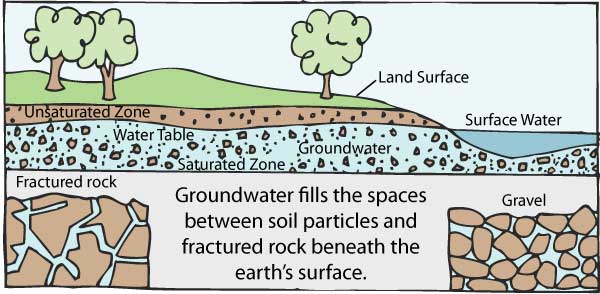
Frannie talked with her family and friends about why it is important to protect freshwater - because we all rely on it!  Freshwater is the water we use to grow our food, to drink, to play in, to bathe, and the list goes on and on.  Most of the world's usable freshwater is stored under our feet as groundwater:

 
Courtesy of the United States Geological Survey.


Check out The Groundwater Foundation and Frannie's previous posts for fun ideas of ways you can protect and conserve groundwater!

World Water Day emphasizes the importance of water to us all.  Water is one shared resource.  We must all do our part to ensure the world's freshwater is taken care, used wisely, and is available to all of us!  Share how you will help protect water resources and be sure to tell your family and friends about protecting and conserving water every day!

Wednesday, March 16, 2016

It's Water-Wise Wednesday with Frannie the Fish {Look, Listen, Discover}

Water is part of everything around us!  Water is vital to everyone, especially to fish friends like Frannie that live in it.  Frannie is going to share a fun activity that combines creativity with the power of observation to discover and explore water's irreplaceable role in our world - all you have to do is look around and listen to your surroundings to see proof of it.

Here's what you'll need:
  • Writing utensil
  • Paper
  • A surface to write on (for example, a clipboard)

Here's what you do: 
1.  Read through The Groundwater Foundation's Safety First Rules.  Remember - always be careful when outdoors and when you are around bodies of water.

2.  Find a local water body that is safe to visit.  Hike around the water body and the surrounding area.

3.   Use the following questions as a jumping off point for observations on your hike:
  • When it rains, where does the water go?
  • What does the body of water look like?  Deep, shallow, calm, choppy, big, small?
  • How does the water look?  Clear, cloudy, dirty?
  • What do the banks look like?  Rocky, rich with vegetation, bare, slippery?
  • How might the weather impact your location?  (Drought, storms, snow, rain, etc.)
  • What potential contamination sources can you identify?  Can you see trash and debris?  Can you see something that might pose a threat to water quality?
  • Do you see aquatic life?  Are there insects in the water, in the vegetation, or under rocks?
  • What types of wildlife can you see or hear?
  • How are people using the water? 
 4.  Write a story, poem, song or draw a picture of what you observed.  Get creative!  There are so many ways we use water and just as many ways we can protect and conserve it!


Share your stories, poems, and drawings with The Groundwater Foundation and you could be featured on Frannie's blog!

---

The Groundwater Foundation and Frannie the Fish want to wish Girl Scouts a happy 104th anniversary of inspiring, empowering and educating girls across the United States!

Wednesday, March 9, 2016

It's Water-Wise Wednesday with Frannie the Fish {National Groundwater Awareness Week}

March 6-12 is National Groundwater Awareness Week!  

Frannie is so excited to celebrate our most precious resource, groundwater.  Groundwater is water contained under the ground's surface, located in the spaces between soil particles and in the cracks of sand, gravel, and rock.  


Groundwater is the source of water for:

  • Drinking - About 51% of Americans rely on groundwater for their drinking water supplies.
  • Irrigation - Groundwater helps grow our food.  64% of groundwater is used to irrigate crops.
  • Recreation - Discharge from groundwater provides water in lakes, rivers, and wetlands that we swim, boat, fish, and play in.  Discharge is an outflow of groundwater from an aquifer.
  • Industry - Groundwater is important in many industrial processes, for example ethanol production and food processing. 

Check out The Groundwater Foundation's Girl Scouts pages to find fun, hands-on activities and great resources to learn more about groundwater and earn two groundwater patches in the process! Here are a few simple things you can do to help protect and conserve groundwater:
Be sure to share what you have learned with your family, your class at school, your friends, and The Groundwater Foundation! 

Find out more about the National Ground Water Association's National Groundwater Awareness Week!

Wednesday, March 2, 2016

It's Water-Wise Wednesday with Frannie the Fish {Fish Feeding Frenzy}

This week Frannie wants to share a fun activity to do with your troop to discover how pollution can affect the environment, water and food sources, including how it can move through the food chain and become more concentrated.  Fish Feeding Frenzy is a great way to learn about biomagnification.  Often pollutants that exist in small amounts in the environment can become concentrated in creatures near the top of the food chain.  For example, in a stream tiny creatures that can't be seen or microorganisms called plankton, may absorb small amounts of pollutants; fish that eat lots of plankton might retain these pollutants in their tissues; birds or people that eat fish might concentrate pollutants still more.  This process is called biomagnification and can produce health problems for many creatures in an ecosystem, including humans.

Here's what you'll need:
  • Pom-poms of assorted colors
  • Identification chart showing what each pom-pom color represents (see the example below)
  • A plastic cup for each Girl Scout labeled as either a "minnow," "little fish," or "big fish."


Here's what you do:
 1.  Start by creating an identification chart to show which pollutant the different color pom-poms represent.  Don't show this chart to the Girl Scouts until after the game is played.  Below is an example list of pollutants used regularly in businesses and homes:
  • Yellow - fertilizers
  • Red - paints
  • Purple - solvents
  • Brown - chemical cleaners
  • White - oil and grease
  • Orange - metals
  • Black - motor oils
  • Green - pesticides
  • Light Blue - safe (contaminant-free) food

2.  Assign each Girl Scout the role of a minnow, a little fish, or a big fish.  Give each Girl Scout the appropriate cup after they are assigned their role.

3.  Scatter the pom-poms all over the ground. 

4.  The Girl Scouts will have two minutes to collect as many pom-poms in their cup as possible with one hand behind their back.


5.  Using the identification card, have the Girl Scouts identify which pollutants they "ate."  How did these pollutants get into the water?  The Story of Frannie the Fish is a great way to learn how pollutants can end up in surface water.


6.  Explain the basic food chain of the game: the minnows end up in a stream where they become a food source for the little fish.  Tell the Girl Scout "minnows" to pour their pom-poms into the cups of the little fish.  This increases the quantity of pollutants that the little fish have accumulated.

7.  The little fish swim to a river where they become a food source for larger fish.  Tell the Girl Scout "little fish" to pour their pom-poms into the cups of the big fish.  The big fish now have a large amount of pom-poms representing different pollutants.

8.  As the big fish swims through the river, they are caught by a fisherman and become the "catch of the day."  These fish become a food source for humans.  Humans, at the top of the food chain, will consume a large quantity of the different pollutants. 

9.  Make a list of ways to keep our surface and groundwater clean from pollutants.

Share pictures of your troop playing the fish feeding frenzy game or your list of ways to keep it clean here!